
Do you know your preferred learning style?


Everyday, we learn new things and we use the term ‘learning’ all the time in our everyday life. Abigail Adams once said – “Learning is not attained by chance, it must be sought for with ardor and attended to with diligence.” In the quest of searching for information, understanding your learning styles is imperative. This help life coaches, trainers, teachers, mentors, and parents etc. to know how best to deliver their programmes or build learning relationships in a more effective way and it can also help you enhance your learning experience.

To start with, why don’t you ask yourself this questions before you proceed?

  • What is my preferred learning style?
  • How best do I learn?
  • How can I improve on my learning experience?

Different researches have shown that people have different preferences and concentrations in how they absorb and process information. These preferences are occasionally referred to as ‘learning styles’ and are used to explain and assist us in understanding the different ways in which different people learn. There are several preferences on learning styles but one of the most famous and widely adopted is Honey and Mumford’s learning style model.

According to the authors of this model, there are four major learning styles. These are:

  • Activists;
  • Reflectors;
  • Theorists;
  • Pragmatists.

Activists – are ‘practical’ learners. They prefer to have a go and learn through test and error. They like to ‘do’ first before thinking of the risk. They tend to act first and consider the consequences afterwards. Their days are filled with activity. They are sociable people constantly involving themselves with others. Activists are likely to say statements like: “Let’s just give it a try and see the outcome”, “Can I try it out?” etc.

An activist philosophy is: “I’ll try anything first time”.

Activists would wants to be involved in a course that is grounded on laboratory investigation for researchers or detailed assignment to develop the skills on the job. In addition, activists enjoy undertaking real-world open and flexible interactive learning programmes, or activity-based training courses (communication and virtual classrooms (Chats like) rather than those that call for quiet study at home on your own. They involve themselves completely and without favouritism in new experiences. Conclusively, activists have an open-minded approach, not doubtful, and this tends to make them eager to learn anything new.

Suggested learning process activities for ‘activists’ are: brainstorming, competitions, role-plays, puzzles, group discussion and problem solving etc.

Reflector – are ‘tell me’ learners. They fancy to be fully briefed before continuing a task or an activity. Reflectors like to think about what they’re learning. They are careful in type and always want to think about things in detail, watch and assess from a variety of angles before taking action. Reflectors are likely to say: “Give me time to think about this”, “I like to take things one step at a time” etc.

A reflector philosophy is: “to be thoughtful”.

Reflectors like time to read around a subject, reflect and also observe others try things out. They prefer courses that will give them time to study in advance, and discuss overtime, rather than just a day course needing their immediate contribution. “Reflectors are relaxed people, they like to think about their experiences and observe them carefully from many different angles. They prefer collecting data (both first hand and from others) and take their time to work towards an appropriate conclusion. They are cautious people and they desire to take a back seat in deliberations and meetings. Lastly, Reflectors enjoy observing other people, listen to others and get the point of the dialogue before making any contribution.

Suggested learning process activities for ‘reflectors’ are: Coaching, paired discussions, feedbacks, books, interviews, self-analysis questionnaires, articles, observing activities and time out etc.

Theorists – are ‘prove me’ learners. They seldom want reassurance that a task or project makes absolute sense. Theorists are interested in knowing how the new knowledge fits into their ‘framework’ and into earlier theories. They tend to be difficult with knowledge that doesn’t fit into existing knowledge of theirs. Theorists are likely to say: “How does this fit in with (x)? ”, “Does it make sense?” etc.

A theorist philosophy is: “If it’s analytical then it’s good”.

Theorists enjoy models and theories, with loads of background information. They prefer courses or assignments that are theory-based rather than case-based. They are perfectionists who won’t relax until things are in order and fit into a logical structure. They like to examine and synthesise. They believe in thinking problems across an upright, step-by-step logical way. They are likely to be isolated, methodical and committed to rational objectivity rather than everything vague or biased. They approach problems in a consistent logical way. They believe in what they know and will refuse anything that doesn’t fit strictly. Above all, theorists are the type of learners who are always curious to understand the theory behind every action.

Suggested learning process activities for ‘theorists’ are: quotes, stories, basic assumptions, philosophies, theories models, systems thinking, statistics, background information etc.

Pragmatists – are ‘demonstrate to me’ learners. They are interested in what works in reality and will only approve of a specialist demonstration. They are experimenter, who enjoys testing out new ideas, philosophies and methods to see if they work in practice. They don’t believe in abstract concepts. Pragmatists are realistic, simple people who enjoy solving problems and making concrete decisions. Pragmatists are likely to say: “How will it work in real-world?”, “How relevant is this to practice?” etc.

Their philosophy is: “In as much as it works, it’s OK!”

Pragmatists prefer interactive or problem-based learning, where they have ample time to think about things on their own, and discuss them with others. They are interested in thinking about the practical applications of what they’re learning. They answer to problems and opportunities ‘as a challenge’.

Pragmatists confidently search out new ideas and take the first opportunity to experiment its real world application. They are the type of people who after training or a course are full of ideas and are eager to try them out in practice. They like to follow things through, act fast and positively on ideas that fascinate them. In conclusion, pragmatists are likely to be irritated with meditating and flexible discussions.

Suggested learning process activities for ‘pragmatists’ are: Problem solving, discussion, case studies, practical books, time to reflect about how to apply learning in real world etc.

Can you identify your learning style after reading this article?

If yes, lucky you but if you can’t and would like to know your learning style using the Honey and Mumford questionnaire, drop your e-mail at the comment space below this post and I will send you a copy of the questionnaire.


HOW TO IMPROVE YOUR LISTENING SKILLS


Listening is the key to communication. For a continuous effective communication, there is a need to always improve on our listening skills from time to time.

Here are tips that can help you improve on your listening skills written by Steve Rose as published on “Transitions”.

Click here to access the article and please do share your views in the section below this post. Also, follow my blog to get resourceful information that can help any organisation stay competitive, innovative and profitable. (The follow button is at the bottom of this page).

8 Biggest Limiting Beliefs of Young Entrepreneurs


Some entrepreneurs are seen as world changers either young or old e.g. Howard Schultz of Starbucks, who had to come back to the company he originally built to reinvent it or Reed Hastings who turned a forty-dollar video late fee into a disruptive upstart called Netflix. You also can be seen as one of the world changers. All you need is to start that business you have been procrastinating about today. Some of the common traits you need to kick-start the business are passion, confidence and persistence. Even Steve Case of AOL said “You shouldn’t focus on why you can’t do something, which is what most people do. You should focus on why perhaps you can, and be one of the exceptions.” As an aspiring or young entrepreneur, don’t be afraid to fail because that is one of the biggest limiting factors why people are stagnant. Don’t forget what Albert Einstein said – “A person who never made a mistake never tried anything new.”


Here are 8 limiting beliefs of young entrepreneurs and 8 powerful re-frames examples to consider written by Aleks George Srbinoski as published on the Fulfilling Happiness blog.

Click here to access the article and please do share your views on other beliefs or re-frames examples in the section below this post. Also, follow my blog to get resourceful information that can help any organisation stay competitive, innovative and profitable. (The follow button is at the bottom of this page). Thanks for reading.

7 Terrific Leadership Lessons From Amazing Women


Leadership can be defined in so many ways but here are 3 variations of leadership definitions: –

  1. According to Daphne Mallory of the Daphne Mallory Company, “Leadership is the art of serving others by equipping them with training, tools and people as well as your time, energy and emotional intelligence so that they can realize their full potential, both personally and professionally.”
  1. As defined by Mindy Gibbins-Klein of the REAL Thought Leaders, “Leadership is having a vision, sharing that vision and inspiring others to support your vision while creating their own.”
  1. According to Katie Easley of Kate Ryan Design, “Leadership is stepping out of your comfort zone and taking risk to create reward.”

Lately, women have been seen occupying power positions in various organisations and joggling the leadership seat with men. As stated by Zeneger Folkman, women have been found to be more of a better leader than men. Hence, there are several key lessons that could be learnt from women in leadership positions. Below is an article written by Yasmina Yousfi titled 7 Terrific Leadership Lessons From Amazing Women, which explain further how women perceive leadership as compared to men and how men can be of a better leader by learning from them (women).

Click here to access the article and please do share your views in the section below this post. Also, follow my blog to get resourceful information that can help any organisation stay competitive, innovative and profitable. (The follow button is at the bottom of this page).

15 Customer Retention Strategies that Work


Taking charge of the most profitable recurring customers is a great way to build business success because keeping good customers is less costly than regularly finding new ones. Therefore, Customer retention can be seen as the action that a business undertakes in order to reduce customer shortcomings. Before a business can claim a successful customer retention, it depends on the kind of contact or relationship such business builds with its customer at present and throughout an entire lifetime. To continuously improve your existing customer retention strategy, here are 15 Customer Retention Strategies that Works as published by Gregory Ciotti on Help Scout. (Click here to read).

Don’t forget to check out my past articles on how to know your team role and also, how to use SERVQUAL model, 5WHYS and PDSA tools to improve your customer service processes. Thanks for your time.

To find out more about how I can be of help to you, send me a connection request on LinkedIn, or send me a message directly.

EMAIL Temitope Adelekan

LINKEDIN https://ng.linkedin.com/in/temitopeadelekan

FOLLOW me Twitter http://www.twitter.com/taymethorpenj

WEB https://www.temitopeadelekan.com/

JOB Interview: To Be A Hired Candidate, Do Your Homework


If you want to be successful at your job interview, here are proving ways that has worked for billions of people. Rather than wasting time trying to connect and asking what are the likely questions to look forward to from friends and colleagues, sit yourself down and do your own research. Your homework would be your lifeline when you are on that hot seat in front of a potential employer. So, panic not. Even Julius Caesar said, “No one is so brave that he is not disturbed by something unexpected”. Stay courageous! And nail that interview.

Below are the few Job interview success tips that can land you that dream job: –

BEFORE

  • Tidy your Social Media accounts (e.g. who are you on twitter, Facebook, kik, Instagram).
  • Get on LinkedIn (e.g. create one if you don’t have or update your existing profile).
  • Do your homework (e.g. what do you know about the company? What do you know about the role you are applying for?).
  • Re-read and practice your answers (e.g. can you remember or defend what is on your CV?).

DURING

  • First impression matters (e.g. great smile; no one says a professional handshake is a crime).
  • Smart appearance (e.g. appearance is not major but dress the part).
  • Shun anxiety (e.g. always give concise and detailed answer; be straightforward).
  • Body language is important (e.g. where is your eye contact? To the floor or ceiling?).
  • Build relationship (e.g. make the interview conversational and remember to stay focus).
  • Recap (e.g. don’t guess an answer if you are not sure what the interviewer is asking. Simply tell the interviewer to come again or better still to repeat the question).
  • Ask questions about the company (e.g. what organizational culture do you practice here? This helps you to demonstrate your interest in the company to the interviewer).

DURING AND AFTER

  • End with a thank you message (e.g. thank you for your time and I look forward to meeting you again. Could be during the interview, through email or letter).

What is your own job interview experience? Please share, it can help somebody get hired today.

Please Don’t forget to check out my past articles on how to know your team role and also, how to use SERVQUAL model, 5WHYS and PDSA tools to improve your customer service processes at: http://temitopeadelekan.com. Thanks for your time.

To find out more about how I can be of help to you, send me a connection request on LinkedIn, or send me a message directly.

EMAIL Temitope Adelekan

LINKEDIN https://ng.linkedin.com/in/temitopeadelekan

FOLLOW me Twitter http://www.twitter.com/taymethorpenj

WEB https://www.temitopeadelekan.com/

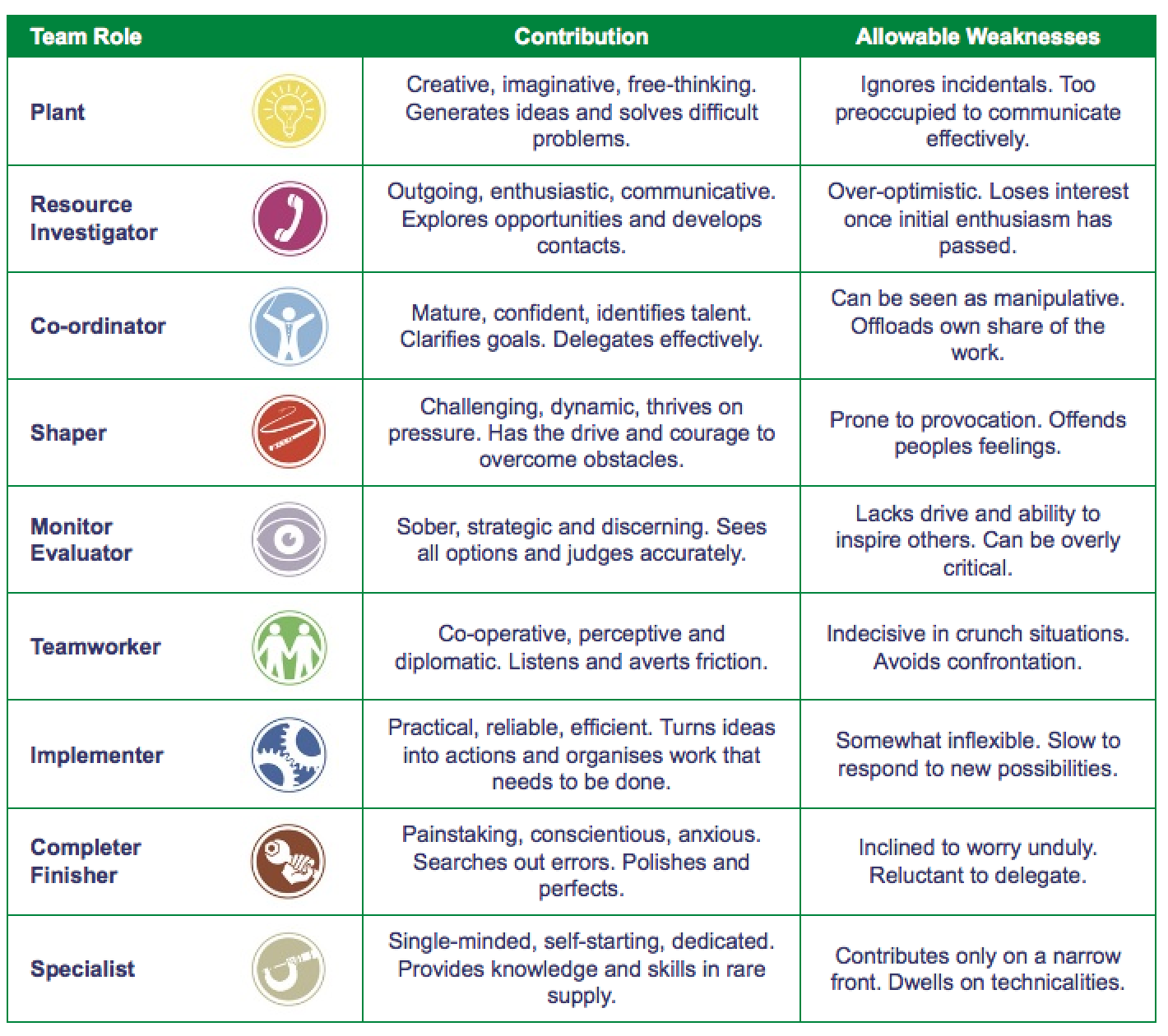
Knowing your team role using the Belbin chart


Understanding human behaviour plays a crucial role in a team success from the start to a finish of any project. Therefore, realising each member’s team role from the chart below will help you as an individual to know whom you are and how to behave when you find yourself as part of a team. Feel free to share your opinion on your preferred team role, add or argue if you agree with your listed contributions or allowable weaknesses. Thanks

Source: TrainingGearAsia

How To Use SERVQUAL Model, 5WHYS And PDSA Cycle Tools To Improve Your Customer Service Processes


Without customers, there won’t be a product, there wont be people working tirelessly to provide solutions to the needs of people. With this knowledge, understanding how customers feel about a service, what they think of a service, how satisfied they are about a service etc. is key and this can contribute to the growth of any business (Increased profit, Customer loyalty and retention etc.) which is why a whole department is dedicated to that cause to show how important customers are to any business). A customer service department handles all customer related affairs of a business. They are the first point of contact. Delivery of services in this department impacts on customer experience and having an effective customer service process in place can help ensure customer satisfaction which can then lead to retention, loyalty and growth. Here are the 3 required tools you can use to improve your customer service delivery processes: –

Tool 1: SERVQUAL METHODOLOGY

Servqual is a service quality-measuring model that can be used to measure and manage the quality of service in an organisation. Service quality plays an important role in most service firms and it is antecedent to other concepts of profitability, customer satisfaction, customer loyalty and customer retention. To measure this, a questionnaire is deployed to understand and measure the expectations and experience of customers regarding a particular service offered to them. The survey will be used to identify a gap in the customer’s perception and expectation of a particular service.

The survey questions are asked following the dimensions of SERVQUAL known as “RATER” (Responsiveness, Assurance, Tangibility, Empathy and Reliability). This model allows customer service experiences to be investigated and measured quantitatively. This has been used extensively by service delivery organisations and it can be adapted to suit your study area e.g. if you want to apply servqual in a grocery settings, “Products (P)” can be added to the original model (RATER) and measured to understand how customers feel about the offering, making the new dimension “RATERP” in measuring and managing service quality in this context. The customization attribute of SERVQUAL is applicable to all service areas, which makes it one of the most widely used tools in measuring the quality of a service.

The original 5 dimensions (RATER) are briefly explained below:

  • Reliability: This is the ability to achieve the promised service reliably and correctly;
  • Assurance: The understanding and politeness of employees and their ability to communicate trust and confidence;
  • Tangibles: The look of physical facilities, equipment, employees and communication tools;
  • Empathy: This is the provision of care and personalised attention to customers;
  • Responsiveness: The readiness to support customers and to provide timely service.

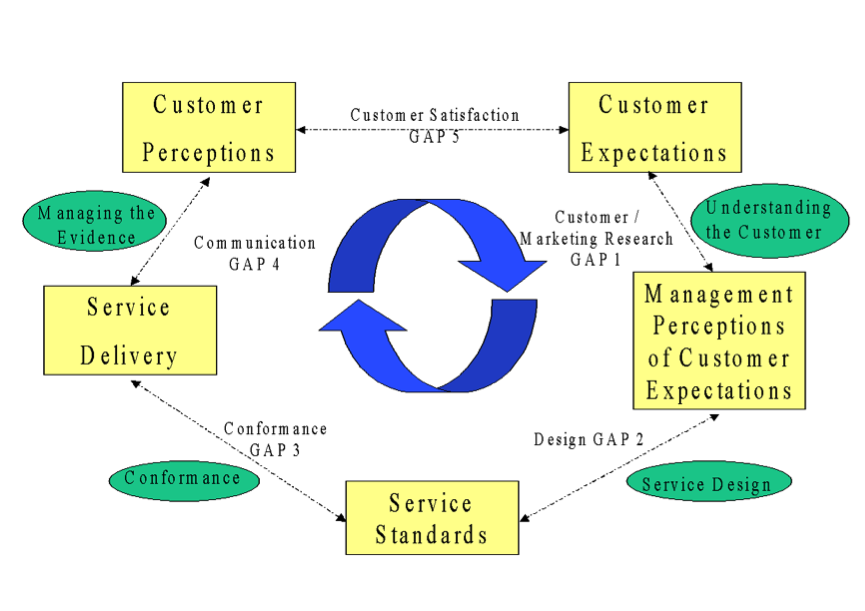
From the questionnaire analysis, if customer expectations are higher than their perceptions of service received, service quality is viewed as low (not satisfactory) but if their perception is higher than their expectations, service quality is viewed as high (satisfactory). As indicated by Dr George Easaw in the Gap model shown below, a low service quality is a gap in the customer service quality process which directly has an impact on customer satisfaction levels. If a customer is not satisfied, it can affect their loyalty and retention which makes it a priority for organizations to identify such gaps using the Servqual tool and examining further to identify the root cause in order to improve the existing service quality processes. To investigate a gap in the service process, employ the use of the 5WHYs tool.

Service Gap Model

Source: Dr. George Easaw

Tool 2: 5WHYS

5WHYS

Source: Brandgenetics

5whys is an effective technique used in correcting and improving an existing process. It is used in the diagnosis of an issue or in this context, the gaps, as well as in identifying other issues that requires urgent attention. It is applied by simply asking the “WHY” question five or more times regarding a particular gap in the service quality processes. This can be compared to how kids learn and improve their speaking skills by probing literarily everything such as: Daddy, why is the dog barking? Why is mummy pampering the dog? They always ask the why questions out of curiosity and in the process of doing so; they acquire some vital knowledge and improve their communication skills. This is the same in a business environment. It is like peeling off the back of an orange till you get to the finer skin or peeling off a yam till you get to the inner skin. The following is an example of a scenario where the 5WHY was applied to determine the root cause of an issue:

Problem statement:

The customer is unhappy because his pamphlets were delivered late and it didn’t meet his program timing.

Outcome:

The customer pamphlet delivery arrived late. Why?

There was a shortage of printing ink. Why?

Spare ink had to be found. Why?

The ink was replaced but eventually the printer alerted the technician wrongly. Why?

It had not been crosschecked after replacement. Why?

Root cause

There is no machine checkup/maintenance schedule. Putting up a good checkup/maintenance schedule in place after every ink replacement will help ensure that printer will continue to work effectively and never disappoint due to ink replacement. This reduces delay and will help improve the process.

5whys is very easy to use and can be completed without the use of any statistical analysis. Here are four steps to follow when applying this tool in a service quality improvement process:

  • Write down the problem statement. Putting the issue in text will help you describe the issue clearly and help you validate it. It also keeps a team focus and put their eyes on the big picture which it to prevent it from recurring.
  • Question why the problem occurs and note down possible answers. This is mostly achieved through brainstorming.
  • Check the possible answers noted in step two with the problem statement in step one and if it doesn’t identify the root cause, ask the why question again and note down your possible answer.
  • Repeat step three until an understanding is reached and the issues root cause is identified. Have it in mind that the why questions might be asked fewer times or more than the 5whys before we achieve our aim.

After identifying the cause of the gap in service quality, the next step is to fill it by improving the existing processes, which leads us to the third tool known as the PDSA Cycle tool.

Tool 3: PDSA (Plan, Do, Study and Act)

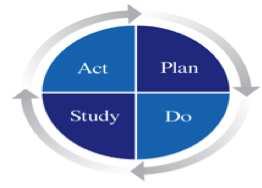
The PDSA technique is known as the Deming Cycle or Deming wheel. Walter Shewhart, first introduced the model and application to Dr. Deming. The PDSA Cycle is a logical chain of steps used in gaining valued knowledge for the continual improvement (CSI) of a process or product. It can be used as a simple repetitive cycle to drive continuous quality improvement of any customer service processes (CSPs) as shown in the diagram below:

Deming Wheel

Source: The W. Edwards Deming Institute®

If a business want to stay competitive and successful, it needs to address the root cause of service quality issues and constantly drive improvement at the CSPs to avoid poor service delivery. As demonstrated by the diagram above, you need a plan on how to address any issue identified in service delivery, implement the plan (processes) by doing, study the new processes meant to improve the service in other to check if it is serving its purpose and act accordingly. This will help fill the gap initially identified and it will continuously ensure that customer’s perceptions of the services are higher than expectations.

Conclusively, the three techniques (SERVQUAL, 5WHYS & PDSA) are individual tools but if combined together by a professional in any service environment, one can continually achieve enhanced customer delivery processes that will then lead to customer satisfaction, loyalty and retention.

How have you been able to improve the customer service processes in your organization? Kindly share your suggestions in the comment section below or through your preferred social network. Thank you.

Hello world!


This is your very first post. Click the Edit link to modify or delete it, or start a new post. If you like, use this post to tell readers why you started this blog and what you plan to do with it.

Happy blogging!