Workplace productivity is a business goal that may require two things to become attainable. The first is the investment from the company and secondly, the implementation of friendly human resources (HR) policies such as incentive programs for employees.
Research backs the idea that a top precursor to workplace productivity is to have a reward system in your organisation. While the company will need to allocate financial resources toward employee incentives, the rewards are all encompassing across crucial areas in the business.
One study done among UK companies says explicitly that 85 percent of workers felt highly motivated when there were incentives at stake. And not only that, 73 percent of the employees observed a “good” or “very good” office atmosphere during incentive season. For the company, the benefits of an incentive programme are quite pronounced as the study also found that employee productivity is tied to as much as £80,000 ($106,00) increase in weekly profit on average.
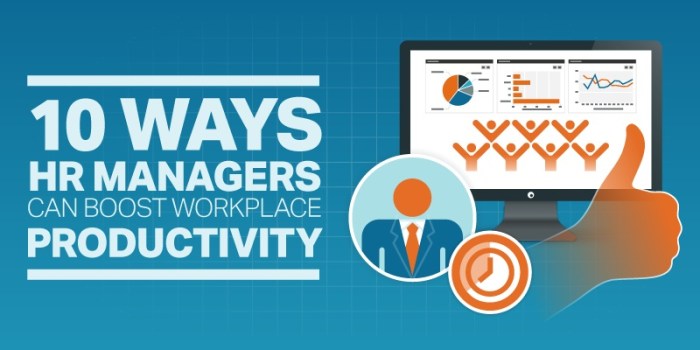
Below is an infographic that shows the different ways HR managers can further boost productivity in the workplace. Feel free to add your suggestions in the comment box below.
Feel free to share on social networks. Find the buttons below this post. This opinion article is for informational purposes only.
Remember, information/knowledge is never enough in our world. Let us spread the word!
Twenty years ago, collaborating with people in real-time over the internet seemed difficult to understand. Now we do it every day with the click of a button. Google Docs is a powerful tool that makes working with people both near and far a breeze, but do you know how to use it to its full capacity? Go beyond just sharing docs and leaving comments with these 24 Google Doc hacks and add-ons.
Excited to save some time? With these hacks you no longer have to manually go through a document and look for duplicates or change the capitalization structure letter by letter. Though these may just seem like minor details, they will make a major difference in productivity!
To keep your files neat and organized on your computer, you can go the extra step and download Google Drive for Mac. This will save and sync your files on both your hard drive and in the cloud, so you have a backup.
You can also download the Google Doc phone application to easily view documents when you’re on the go. If you’re worried about losing internet connection and have to do a last minute edit, you can set particular documents to be available offline. Just click the three dots next to the document’s title and choose “Available offline”. These documents are automatically put in an “Offline” folder.
Staying organized is the key to managing your workload and optimizing your time, and these easy, actionable tips are sure to help you do just that.
Feel free to share on social networks. Find the buttons below this post. This opinion article is for informational purposes only.
Remember, information/knowledge is never enough in our world. Let us spread the word!
Regardless of what industry you work in, chances are you’ve probably dealt with spreadsheets in some capacity. Using spreadsheets typically means using Microsoft Excel.
Excel is far and away the leading spreadsheet software as it is used by most businesses. However, Excel has a bit of a learning curve, and if you’re new to the program, it can be a bit overwhelming.
Fortunately, GetVoIP has created an infographic that shares tips, shortcuts, and hacks for using Microsoft Excel more efficiently. These hacks include:
Selecting all cells.
Inserting new rows or columns.
Bolding, italicising and underlining text.
Inserting date and time.
Switching between formulas and values e.t.c
Below is the visual to learn the highlighted tricks and other helpful keyboard shortcuts for Excel.
Feel free to share on social networks. Find the buttons below this post.
Remember, information/knowledge is never enough. Let us spread the word!
Do you ever feel like the stress at work is getting to you, and you need to take a breather?
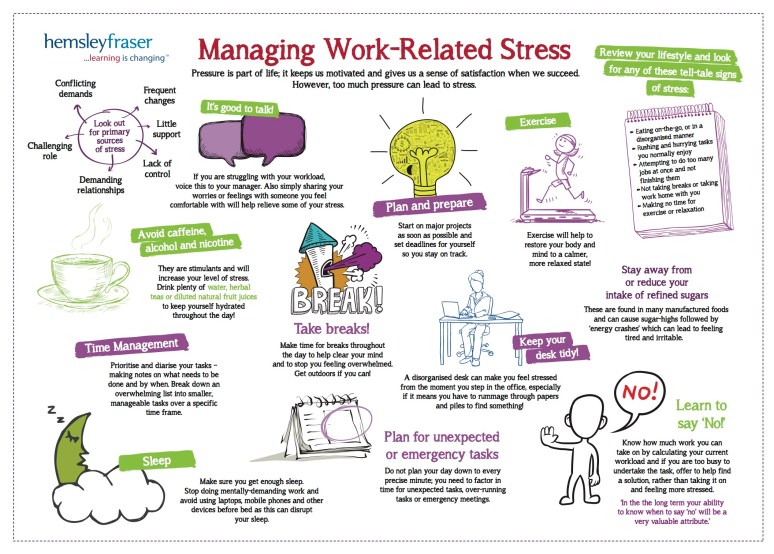
I believe this infographic can help you understand how to handle stress because stress is something most people deal with on a regular basis. And not everyone knows how to cope with it, especially at work. Please, find below the infographic:
Hope this is helpful?? Feel free to share on social networks. Find the buttons below this post. Remember, information/knowledge is never enough. Let us spread the word!
I’ve traveled solo while working full-time for ten-plus months, across more than 15 countries. It’s one of the most fun and rewarding things I’ve ever done. My work breaks over the past year have included things like scuba diving in Belize, polo lessons in Buenos Aires, music festivals in Hungary, and more.
Working full-time while on the road is not easy, but it’s definitely a skill that can be mastered over time.
For those interested in the nuts and bolts of how to travel while working, there are already several great articles out there explaining how it’s done. If you’re not familiar, I recommend starting with Toptal COO Breanden Beneschott’s guide.
In terms of logistics and planning, pulling off a full-time work schedule while on the road is much easier and cheaper than you probably think (at least in my experience), and the infrastructure for doing so continues to grow rapidly.
However, the following problem is far more difficult to solve, especially when traveling solo: Can you fully enjoy your travels while not sacrificing the quality of your work?
Striking The Right Balance
Can you navigate travel logistics, work full-time, and take care of yourself physically and mentally, all while setting aside enough time to explore the places you’re visiting, find fun things to do, and meet new people?
Since you won’t have much of a support system when you’re alone in a foreign country and (usually) don’t speak the language, finding the right balance is critical. Your routine has to be sustainable in the long run, and if you aren’t careful, things can go downhill in a hurry.
As I’ve been traveling, I’ve gotten a lot of questions from friends and colleagues about the psychology of this lifestyle, including everything from how to avoid loneliness to how to maximize productivity.
It’s not for everyone, but this lifestyle can be both incredibly fun and extremely productive, provided you figure out how to do it in a way that works for you. As I’ve traveled, I’ve noticed some key habits, mindsets, and tricks that are important for anyone who is considering working and traveling to keep in mind, regardless of their occupation or interests.
This post covers some of the most important strategies I’ve picked up while on the road.
Go To X To Do Y
When you have the option of living anywhere, it can be difficult to choose a destination, and going to places to see/do touristy things can get old fast. I’m a big fan of going to places to do specific (non-touristy) activities, as opposed to just going to places that sound interesting on paper.
Working full-time and traveling the world might be easier than you think, especially when you’re traveling for a purpose.
I’ve found that having a purpose to your travels leads to a few great outcomes:
It’s a lot easier to structure your time and priorities.
It’s easier to meet fascinating people with shared interests.
You learn amazing new skills that you’ve always wanted to learn.
When you’re traveling solo and devoting a lot of time to work, it’s important to limit the extent to which you’re “re-solving” the same problems on a daily basis. What I mean by that is, you don’t want to find yourself waking up every morning without any plans for where you’re going to work, what you’re going to work on, where you’re going to eat, who you’re going to meet, what non-work things you’re going to do, and so on.
Not only is it easy to waste a lot of time and energy answering the same questions over and over again, but it will also quickly make you feel like you’re swimming in circles without accomplishing much.
To be clear, I am just as strongly against doing anything that’s “too organized” while traveling. I’m pretty averse to resorts, guided tours, and so on.
As a good friend of mine likes to say:
“I always love seeing big cruise ships. The more I see of them, the fewer people there will be wherever I am.”
The adventure and uncertainty of traveling is half the fun, and it’s important not to lose sight of that by planning too much.
In short, don’t just go to Thailand. Go to Thailand to motorbike from Bangkok to Chiang Mai. Go to Brazil because you’ve always wanted to experience Carnival. Go to Nepal because you dream of hiking the Annapurna trail.
The possibilities are endless, and it’s when you go somewhere with a goal in mind that things begin to take off.
Set Aside Time Every Day For Learning
When you’re working at a startup, there are always a million different tasks that need to be accomplished, and you’re constantly in a race against time. You can easily spend all of your waking hours knocking things off of your to-do list, and with so much that needs to get done, it can be hard to justify investing time in anything that’s not the task at hand, or at least directly related to the task.
Being on the road is no excuse for complacency. You can work, play, and master new skills, just as you would from home.
In your workplace, there is always someone you are influencing indirectly either in a way that is good or the other way. So therefore, leaders of organisations pay attention to their employees more than ever before. Leaders mentor their followers passionately and constantly, work towards creating a happier workplace for employees to carry out their duties every single day. This act can be seen as one of the ways to boost the morale of employees’ positively in order to affect the ROI aside other organisational goals.
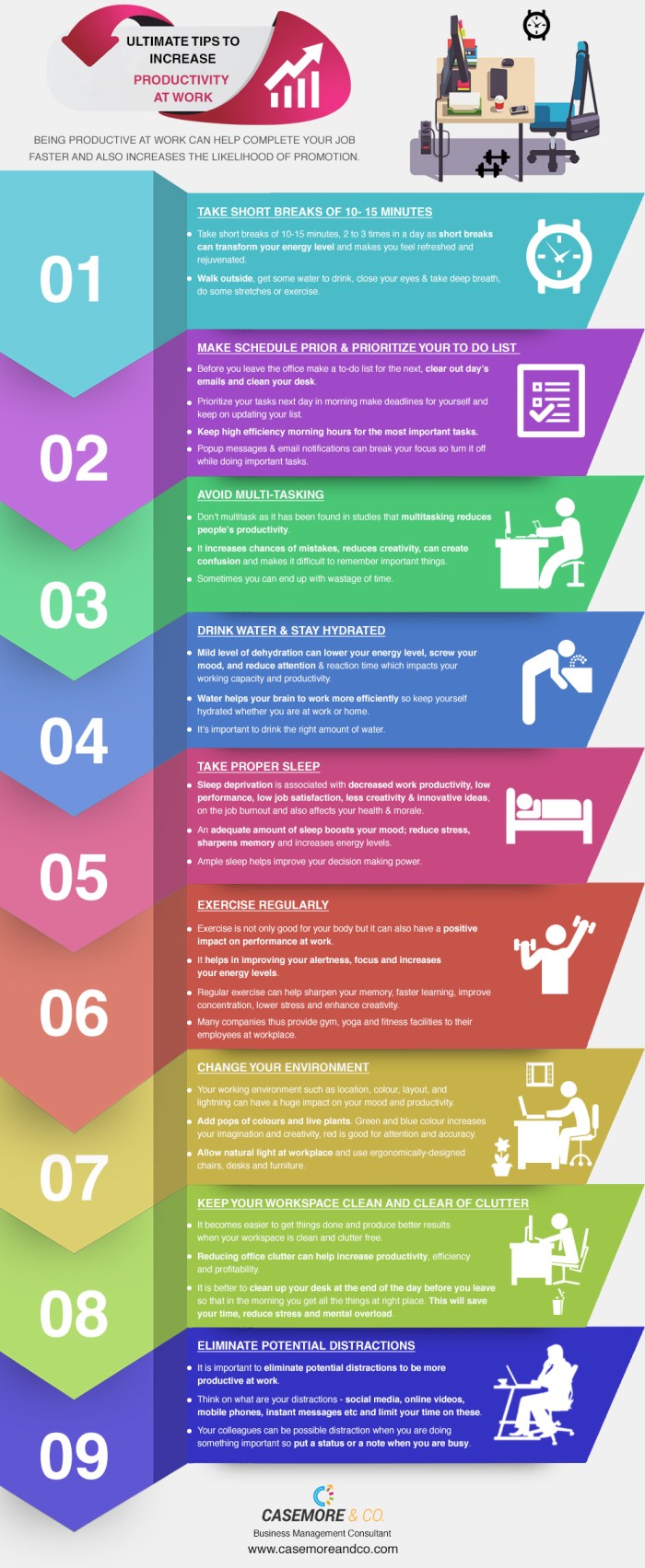
As leaders of organisations, our focus should be about how to empower, how to maximise employee’s potentials and also, to make their lives easier by equipping them with the right information needed day in day out. If and when we can practise these little things religiously, then we can be rest assured of achieving our desired organisational mission, vision and growth. Below are 9 ultimate tips to help employees’ increase their productivity at work.
Thanks for taking out time to read through. Feel free to share on social networks (social networks sharing buttons below – Share with love), drop your suggestions below or contributions.
As a believer and advocate of “improvement” be it plans, processes or techniques to achieve improvement for humans and businesses, I am of the opinion that feedback is the simplest and the most effective way to achieve improvement while reducing costs. As we may know, improvement could mean an upgrade, a refinement, advancement, or being better than before depending on the context we are looking at things either towards human improvement or business improvement. Once again, I strongly believe in the power of feedback towards human growth or business growth.
What is feedback? A feedback is an information or statement of human views about something.
Feedback can be described as a result gotten after a reaction/introduction into a live environment – a real world experience. Feedback also occurs when an environment reacts to an action or behaviour. Knowing that feedback is an essential part of growth, it can help an individual or business raise awareness of strengths and weaknesses for improvement.
E.g. In terms of expectations from people’s point of view, feedback can provide clear indications of how great you are as a person and how to be a better version of yourself (for individual who is an employee – feedback can come through a performance statement from your line manager) and in a case of business, feedback can give clear indications of how great a product is, how efficient a process is, how fast a service is or how horrible a service is from the customer’s viewpoint etc.
It is good for us to know that feedback can come in two ways but the gathering/processing of feedback comes in various ways.
Positive way – This comes in terms of praises
Negative way – This comes in terms of criticism
Both one is very helpful and experts believe constructive feedbacks should have both, telling you what you are doing right and what you should improve upon.
From experience, most people will argue feedbacks are towards change. Please share your answer below.
Here is what the experts are saying about feedback:
To conclude on this short write up, the business/organization doing great today are the ones constantly asking and searching for ways to do things differently, be best at what they do, how to serve people or organisation better. Always know that an effective feedback motivates, helps individual be a better version of self, helps businesses improve on performance, promotes growth and also, open up opportunities for learning and development.
NB: It is advisable to promote and encourage continuous improvement either for human improvement or for business improvement.
Remember, information/knowledge is never enough. Let us spread the word!
Thanks for taking out time to read through. Feel free to share on social networks and drop your suggestions or contributions below.
In my own definition, risk taking is the thin line between success and failure. It’s either you get it right or wrong. While risk taking will help you identify what works and what doesn’t; It can actually get an Individual one step closer to achieving their dreams likewise organizations.
Would you rather take risk or let it rot inside you all in the name of fear? Would you give chance to procrastination or rather give it a try? What if you get it right the first time? What would be your story? What if you miss your chance? What would be your story?
But before the quotes, can anyone please help me define what ‘calculated risk‘ is?
Below are my 10 quotes on risk taking that would inspire you to make a move and be a step closer to your next big innovation.
1
2
Do the one thing you think you cannot do. Fail at it. Try again. Do better the second time. The only people who never tumble are those who never mount the high wire. This is your moment. Own it – Oprah Winfrey
Thank you for taking out time to read my blog. Few weeks ago, I shared 7 must know Microsoft excel tricks to improve performance on this platform. If you haven’t checked out the article, you can do so by clicking here. Hope you found it useful and have been able to switch things up using what was outlined in the infographic.
Today, I will be sharing tips on how you can become a PPT (PowerPoint) power user.
Work-related stress is a rising problem around the world. It arises when a job or different work demand surpasses the power and competence of a person to cope. Some of the common work-related stressors are: The work environment, organization culture, change process/management, job contents, bad/horrible bosses e.t.c.
Individuals differ. Jobs that I may feel or see as stressful, to another might sound or feel interesting. So therefore, factors like a person’s psychological nature, personal life, health, state of mind play a huge role in understanding and managing stress at work.
There are various signs of work related stress. In this article, I will limit and classify them into the 3 common parts that are:
Physical
Emotional
Behavioural
Examples of work-related stress physical signs are:
Headache
Insomnia
Constipation
Fatigue e.t.c.
Examples of work-related stress psychological signs are:
Overwhelming
Anxiety
Irritation
Discouragement e.t.c.
Examples of work-related stress behavioural signs are:
Reduction in work performance
Reduction in creativity level
Mood swings
Aggressiveness e.t.c
Can you identify with any of the listed signs?
If yes, there is no cause for alarm. Together, we can successfully manage and further prevent work-related stress. Below is an infographic on managing work related stress.
It is advisable we practice these tips daily and also, share the information with colleagues, friends and family. If taken seriously, below are 4 projected benefits:
Increased self/work productivity
Greater job satisfaction
Improved employee health
Less illness and lost time/fewer injuries. E.t.c.
Remember, information/knowledge is never enough. Let us spread the word!
Thanks for taking out time to read through. Feel free to share, drop your suggestions or contributions.